
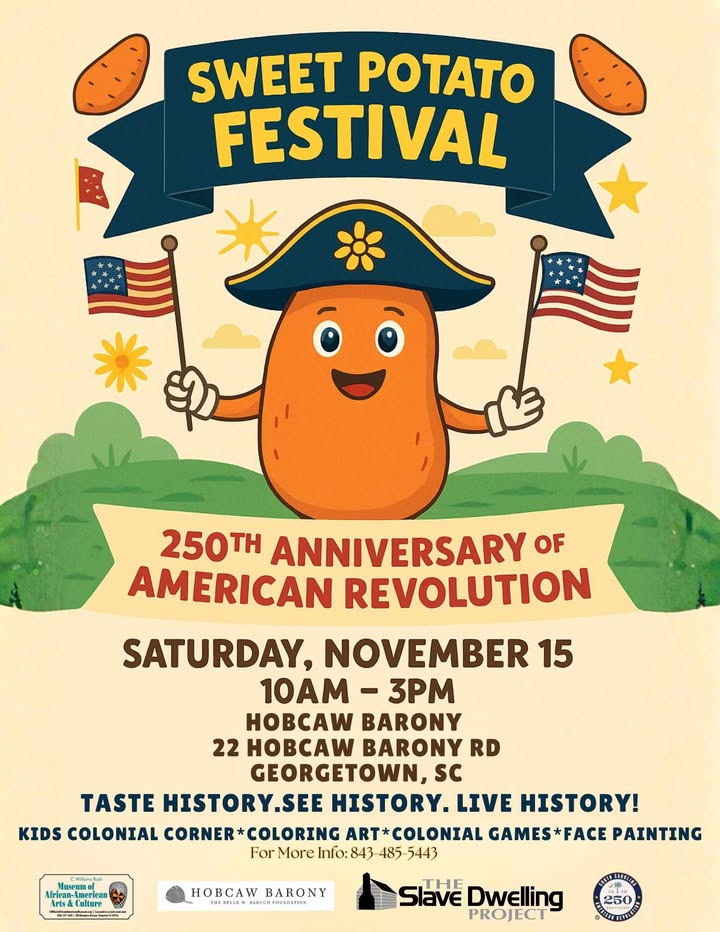
As Thanksgiving nears and sweet potato pies make their way to family tables, South Carolina is pausing to honor a humble root that’s been part of our land, and our history, for centuries. On November 15, Georgetown County, in partnership with Williamsburg County 250 and several other organizations, will host the Sweet Potato Festival at Hobcaw Barony, celebrating this humble crop’s role in sustaining the Revolutionary spirit that shaped our state and our nation.
“Taste history. See history. Live history.” That is the invitation for the festival which is part of South Carolina’s commemoration of America’s 250th anniversary. The event will feature live reenactments, a sweet potato pie contest, artisan vendors, children’s activities, and storytelling that brings our state’s history to life. It is being supported by a grant from the South Carolina American Revolution Sestercentennial Commission (SC250).
A Revolutionary Root
During the American Revolution, sweet potatoes were not just food, they were a lifeline. South Carolina’s swamps and fields provided nourishment for Patriot fighters like General Francis Marion, the legendary “Swamp Fox,” and his militia. In the dense wetlands of the Lowcountry and Pee Dee, Marion’s men survived on roasted sweet potatoes cooked in campfire ashes.
One of the most enduring stories from this era tells of Marion hosting a British officer who came to negotiate a prisoner exchange. Seated on a log in the swamp, the officer was served a simple meal of roasted sweet potatoes. This “sweet potato dinner” became a symbol of Patriot determination and strength. It was a testament to South Carolina’s ingenuity and grit during one of the most trying periods in our history. It was later featured in artwork and even appeared on South Carolina currency.
The Painting That Made the Story Famous
The story of Marion’s “sweet potato dinner” didn’t just survive in history books, it was immortalized on canvas. The oil painting General Marion Inviting a British Officer to Share His Meal by South Carolina artist John Blake White, captures that humble moment when the Swamp Fox offered those roasted sweet potatoes to the British officer deep in the swamp. White, who grew up near Eutaw Springs, painted the piece in the mid-1800s and knew Marion since they grew up together on their neighboring family farms. That makes this painting possibly the closest likeness of the Swamp Fox ever created.
The painting was later presented to the U.S. Senate in 1899, along with several of White’s other Revolutionary War scenes. If you look closely, you’ll notice another key figure. It is the man tending the fire behind the table, roasting sweet potatoes in the pan. His name was Oscar. He was General Francis Marion’s enslaved servant and aide, who served alongside him for seven years during the war. Oscar’s role, once overlooked, has since been recognized. In 2006, he was honored as an African American Patriot during a ceremony at the U.S. Capitol.
White’s painting became one of the most beloved Revolutionary War images in America. The South Carolina American Revolution Trust, which was created to preserve, protect and promote the stories, artifacts and history of South Carolina’s role in the American Revolution, is proud to have a rare print of the scene as part of its collection.
Oscar’s Untold Story
The story of Oscar reminds us that history is rarely simple and never belongs to one person alone. His presence in the painting, tending the fire while history unfolded around him, represents the countless men and women whose lives and labor helped shape South Carolina’s fight for independence.
At this year’s Sweet Potato Festival, his story will take center stage as a full and vital part of our shared heritage. The Georgetown County 250 Committee will honor Oscar’s contributions and the vital roles enslaved Africans played in cultivating and preparing crops like sweet potatoes. It is an enduring legacy that shaped South Carolina’s food history for generations. As we remember the people who sustained the fight for independence, we also celebrate the crop that continues to sustain us in our own kitchens and in restaurants today.
From Revolution to Tradition
Long before the war, sweet potatoes were grown across the Lowcountry, from Edisto Island to Beaufort, where they briefly rivaled cotton as a leading crop. Introduced by early European settlers and cultivated by enslaved Africans, the sweet potato became a staple of both survival and celebration.
Today, South Carolina farms more than 2,000 acres of sweet potatoes, and you can find them everywhere. Look for them at roadside produce stands, on fine-dining menus, and especially on Thanksgiving tables. From pies and casseroles to fries and soufflés, their versatility mirrors the diversity of the people who have cultivated them for centuries.
A Festival Rooted in Community
The Sweet Potato Festival at Hobcaw Barony is a celebration of shared heritage. Visitors can enjoy:
– Living history demonstrations and storytelling by Revolutionary War reenactors
– A sweet potato pie contest featuring local bakers
– Tea tastings, children’s crafts, and artisans showcasing sweet potato-inspired creations
– Opportunities to volunteer, sponsor, or simply come and enjoy the day
Join the Celebration
Sweet Potato Festival
Saturday, November 15, 2025 | 10 a.m.–3 p.m.
Hobcaw Barony, 22 Hobcaw Road, Georgetown, SC 29440
Free and open to the public
Here in the Palmetto State, we don’t just eat sweet potatoes, we honor them. They are a symbol of resilience, community, and flavor, from the Revolution to today. We hope as you sit down to sweet potatoes on your Thanksgiving table, you take a moment to pause and reflect on the rich history that endures today.
About the South Carolina American Revolution Sestercentennial Commission (SC250)
Chartered by the South Carolina General Assembly, the South Carolina American Revolution Sestercentennial Commission (SC250) commemorates the 250th anniversary of the Revolutionary Era and highlights the state’s significant role in securing America’s independence. Its mission is to celebrate and promote South Carolina’s Revolutionary War legacy through heritage tourism, educational programs, and economic development initiatives. Learn more at southcarolina250.com.