
Thousands of people hike the trails at Table Rock State Park every year. Others cheer on the Tigers in Clemson, paddle Lake Jocassee, or drive through Seneca on their way to work or school. Few realize these familiar places were once at the center of one of the American Revolution’s earliest and most significant conflicts.
Years before the Patriot victories at Cowpens and Kings Mountain, the Cherokee Wars were already reshaping South Carolina’s future.
For many South Carolinians, this chapter of Revolutionary history is not as well known. Yet learning about the Cherokee Wars helps us better understand how the Revolution unfolded in our state and why its impact reached far beyond the battlefield.
As South Carolina commemorates America’s 250th Anniversary and our state’s role in the American Revolution, the SC250 Commission is helping shine a light on chapters like this. The Revolution touched people in very different ways, and the Cherokee experience is an important part of understanding our shared history.
To understand the Cherokee Wars, it helps to understand what was at stake. To the Cherokee, the mountains, valleys, and forests of what is now the Upstate were more than a place to live. This was home.
The region around present-day Table Rock was known as Sah-ka-na-ga, often translated as the “Great Blue Hills of God.” Cherokee tradition considered Table Rock a sacred place. Not far away, Clemson University sits near the site of Esseneca, one of the Cherokee Lower Towns. Long before classrooms, football games, and a sprawling campus, this was Cherokee homeland. It is a reminder that the American Revolution is not remembered only on battlefields. Its history is woven into the places beneath our feet.
The conflict itself did not begin overnight. During and after the French and Indian War, relationships between British colonists and the Cherokee became increasingly strained as settlers pushed farther into Cherokee lands. By the time the American Revolution began, years of tension had erupted into open conflict, turning South Carolina’s western frontier into one of the Revolution’s earliest battlegrounds.
Many Cherokee leaders aligned with the British, believing the monarchy offered the best hope of protecting their homeland from continued colonial expansion. Patriot leaders, meanwhile, viewed Cherokee alliances as a threat to settlements along the frontier. The result was a devastating campaign that forever changed lives across the Upstate and shaped South Carolina’s Revolutionary history.
In the summer of 1776, Cherokee warriors launched coordinated attacks across the frontier. Patriot militia responded with expeditions into Cherokee territory, destroying all sixteen Cherokee Lower Towns in what are now Oconee, Pickens, Anderson, and surrounding counties. Homes were burned, crops were destroyed, and entire communities were forced to leave the lands their families had called home for generations.
One of the first major engagements took place near Esseneca Ford on the Keowee River on August 1, not far from present-day Clemson University. There, Patriot forces under Major Andrew Williamson encountered Cherokee warriors in a fierce battle that marked the beginning of a devastating campaign through the Cherokee Lower Towns. Following the battle, Patriot forces burned Seneca Town, and over the weeks that followed, they systematically destroyed Cherokee towns and food supplies throughout the region.
Another defining moment came on August 12, 1776, during the Ring Fight near the present-day community of Tamassee. Surrounded by Cherokee warriors, Major Andrew Pickens ordered his men into a defensive circle, pairing soldiers so that while one fired, the other reloaded. The strategy held until reinforcements arrived, and the Cherokee eventually withdrew. The battle earned Pickens the Cherokee nickname “Skyagunsta,” or “Wizard Owl,” a tribute to his determination and leadership in battle.
Today, local SC250 county committees continue to preserve and share the history of the Ring Fight, helping ensure that the people, places, and events connected to this battle are not forgotten.
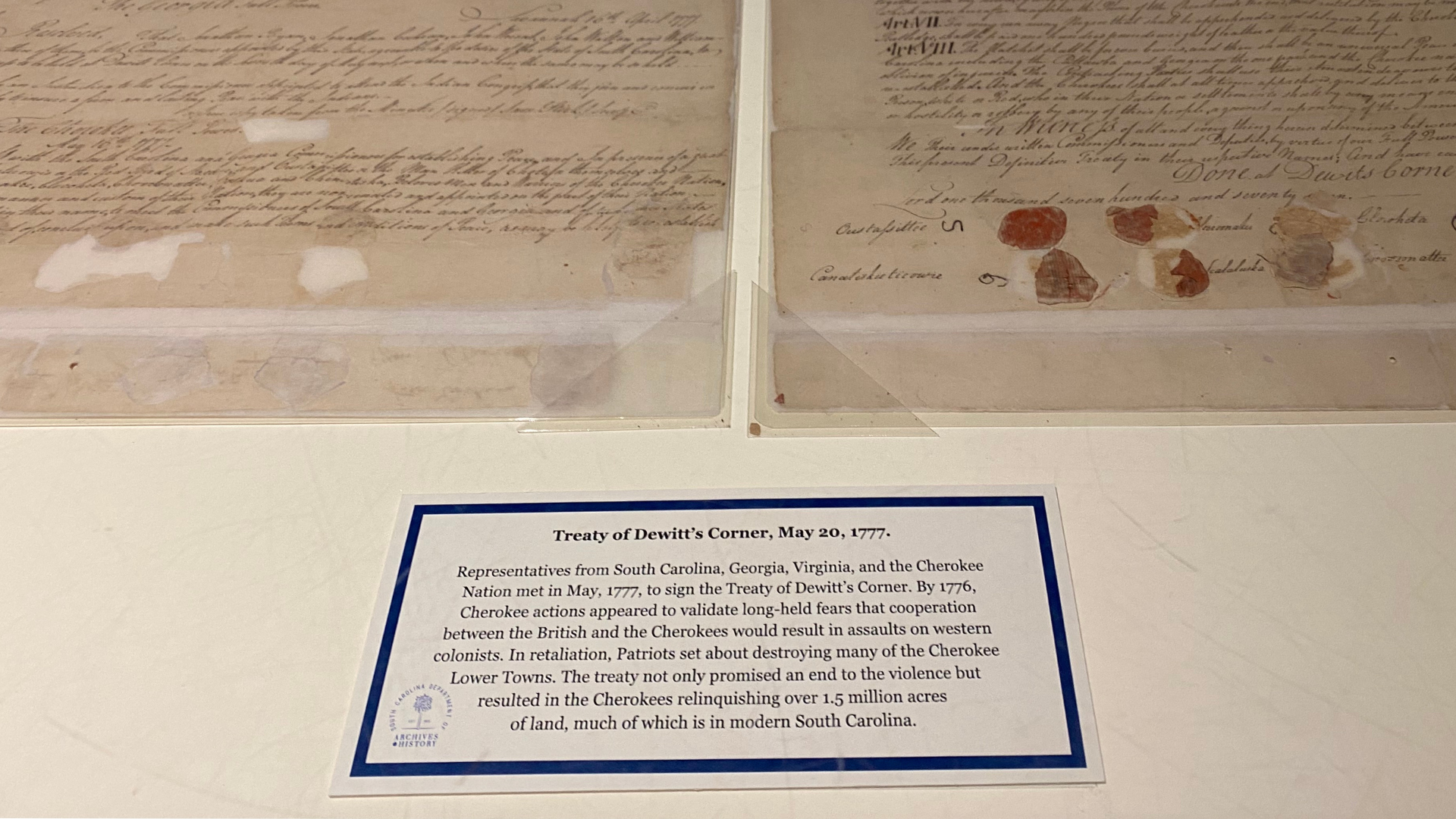
The Ring Fight was only one chapter. The Cherokee Wars were about far more than military victories or defeats. They were about protecting homelands, navigating shifting alliances, and living with the lasting consequences of war. The 1777 Treaty of Dewitt’s Corner required the Cherokee to cede much of what is now the Upstate of South Carolina, forever changing both the Cherokee Nation and the future of our state.
For generations, the Cherokee Wars received far less attention than many other Revolutionary War battles. Today, historians are increasingly recognizing these conflicts as essential to understanding how the Revolution unfolded in South Carolina. They remind us that the fight for independence was also a story of land, loyalty, survival, and difficult choices.
The impact of the Cherokee Wars can still be seen across the Upstate today. Table Rock, Lake Keowee, Lake Jocassee, Seneca, Tamassee, Oconee, and Clemson all occupy a landscape shaped by Cherokee history. Place names, rivers, mountain passes, and historic sites continue to reflect the people who first called this region home.
Through partnerships with historians, educators, county SC250 committees, and organizations across the state, the SC250 Commission is helping ensure this history continues to be shared with new generations. Upcoming programs, including the SC250 Commission meeting in Oconee County on August 24 and conversations with regional partners such as Clemson University, will give South Carolinians additional opportunities to explore this important chapter of our Revolutionary past.
Nearly 250 years after the fighting, visitors can still hike the trails at Table Rock, cheer on the Tigers in Clemson, paddle Lake Jocassee, or drive through Seneca without realizing they are traveling through one of the Revolution’s earliest battlegrounds. The landscape has changed, but its history remains.
As we commemorate America’s 250th Anniversary, we have an opportunity not only to celebrate our nation’s founding, but also to discover the history that has surrounded us all along. The next time you find yourself exploring the Upstate, remember that history is not only found in museums or on battlefields. Sometimes, it is beneath our feet.